Monday, October 31, 2011

Baba Yaga~The Black Goddess

Baba Yaga~The Black Goddess
The story of Baba Yaga is prime among many images of the Black Goddess. The Black Goddess is at the heart of all creative processes and cannot be so easily viewed. Men and women rarely approach her, except in fear. Women are learning of her through the strength and boldness of elder women who are not afraid to unveil her many faces.
 
Sofia as wisdom lies waiting to be discovered within the Black Goddess who is her mirror image. Knowing that, until we make that important recognition, we are going to have to face the hidden and rejected images of ourselves again and again.
As women, we are confronted throughout our lives with unavoidable body messages regarding the uniqueness of our form and the inevitable changes that characterize aging and the passage of time. Although aging presents difficult challenges for both men and women, women confront some specific difficulties because of their gender. In traditional narratives, the end of biological fertility has relegated women to the status of "old women" who are stereotypically viewed as poor, powerless, and pitiful in our sexist and youth oriented culture. Baba Yaga, often referred to as the Black Goddess, and Vasalisa, often representing Sophia (Matthew's 1992, p. 289-90), are intrinsic to the psyche of girls and women because they shows us that the illusion of form can hide wonderful qualities within.
One of the cruelest of stereotypes that older women face is the "menopausal woman." These are accentuated by the very fact that younger women are often rejecting or distancing to older women in society, unwilling to identify with women older than themselves. These experiences are painful confirmations that the aging woman no longer meets the social criteria of a physically and securely attractive woman. The common result for most women is the activation of shame -- as if becoming/looking older means that something is deeply and truly wrong with oneself.

Conscious femininity is a cyclic process (Woodman 1990) and involves an awakened awareness of the triple form of the Goddess - Mother, Virgin and Crone - and how she exists simultaneously and continuously in all of our psyches, each taking center stage in awareness at different moments. These archetypal patterns are considered intrapsychic modes of consciousness in the individual, and the primordial image of a powerful and integrated woman, crowned with wisdom gleaned through real experience, is again reemerging through both the individual and collective psyches of humanity. First, however, women must learn to embrace, respect and honor their changing bodies, abilities, capacities and WISDOM. We can learn a lot from Baba Yaga!

An archetype is a universal symbol, an inherited mental image to which humankind responds, and which is often acted upon as an unconscious reaction to human experience. These stories are no different and the story of Baba Yaga exemplify this phenomena. The female experience is symbolized by and archetypally corresponds with the ancient Triple Goddess as the creator and destroyer of all life -- "the ancient and venerable female divinity embodying the whole of female experience as Virgin, Mother, Crone" (Mantecon 1993, p. 81). The archetypal figure representing the end of a woman's childbearing years, or the "third age" for women, is the third aspect of the Triple Goddess, the Crone.

At the climacteric or menopause, women are often forced to stand precipitously between the culmination of past experiences, to realize that youth is left behind, and prepare a new space within whereby a fresh image will coalesce as she envisions her future. This is real labor. The traditional constructs that are available to women are largely influenced by patriarchal standards of youth and beauty and we need fresh constructs that honor the diversity of life in all of its forms.

When a culture's language has no word to connote "wise elder woman," what happens to the women who carry the "Grandmother" consciousness for the collective? Prejudicial (prejudged) attacks throughout history against older women symbolized patriarchy's feminization of fear: the ultimate fear of annihilation, to be nonexistent (no existence). Centuries-long indoctrination limits our imagination so that we see this ancient aspect of the feminine only in her negative forms. We see her as the one who brings death to our old way of being, to our lives as we have known them, and to our embodied selves.

Our fear of the unconscious makes the Crone or Baba into an image of evil. The prevalence of paranoid masochism finds its expression through feminine perversion. Kristeva (1986) writes from "Stabat Matar" that: "Feminine perversion is coiled up in the desire for law as desire for reproduction and continuity, it promotes feminine masochism to the rank of structure stabilizer" (p. 183).

Structure stabilizer! Natural death is to be feared, hidden away, certainly not recognized as part of the natural rhythm of cycles of birth, death and rebirth? Only when death becomes projected does it become a monster to be feared. There is an unconscious belief that a woman who has outlived her husband has somehow used up his life force. Walker (1985) claims that the secret hidden in the depths of men's minds is that images of women are often identified with death. Women have also bought into this mindset largely because of lost connection with their own spirituality and the natural cycles of nature!

To be sent to Baba Yaga was tantamount to being sent to one's death, but Vasalisa was actually helped by Baba Yaga. By facing her own worst fear -- death itself, Vasalisa became liberated from her previous situation and immaturity.

The myths of our society tell us much about the attitudes and world view of the myth-owners (Kaufert 1982), and these attitudes are the products of women's roles within the wider society. Myth arises out of the collective level of humankind's experience, which is presented through images and symbols that resonate within our psyche. It is something we inherit from our ancestors and it is expressed through our genetic, racial memory. Kaufert (1982) reminds us however, that "myth is a system of values presented as if it were a system of facts" (p. 143).

The symbol of the Crone is unique to a feminine worldview where the face of the Virgin and the fecund Mother, the Virgin Mother Mary, was absorbed in Western tradition into Judeo-Christian imagery. Likewise, we see the image of Vasalisa embodied as this innocence. The Crone has retained much of her pre-patriarchial character where she has haunted the fringes of Western culture, largely ignored, unacknowledged and rejected; one that often strikes fear into the hearts of men and some women because she has tremendous power and cannot be confined (Hall 1992). "Wise women," in the past, were literally seen as having the power of life and death. They symbolized maturity, authority, attuned to nature and instinct. They were women whom men could not bind by making pregnant. They personified, as Hall (1992) writes:
 
"That aspect of life that men would most like to control but against which they are powerless: death. The Crone was healer, seer, medicine woman and, when death arrived with inexorable certainty, she was the mid-wife for the transition to another life (p. 170)."

Over time, and in recent history the Crone became associated with the dark side of the feminine; the withered old hag, the witch. Ironically, the word "Hag" used to mean "holy one" from the Greek hadia, as in hagiolatry, "worship of saints." (Starck 1993). And during the middle ages hag was said to mean the same as fairy.

In deconstructing these familiar images of the older aging woman, we must first identify their symbolic roots and challenge them in order to allow for potent, vital images that energize women's potential creative spiritual evolution. In this quest it is crucial to find valued female images that present creative and spiritual power, that offer a paradigm of ongoing formation and integration. If we do not do so, we risk encountering images of women that reinforce stereotypical models and moreover, can only alienate us from our own truest selves.

The Crone is a figure who incorporates both dark and light, life and death, creation and destruction, form and dissolution. The doll [Vasalisa's doll, given to her by her dying mother] becomes the symbol of the Sibyl, a figure of inspiration and intuition. She acts as a guide through the great passages of life, leading a woman into her own inner knowing.

We see this in the story of Vasalisa and Baba Yaga, the innocence of the maiden coming of age through a series of tasks. Baba Yaga forces Vasalisa to look within through intuition (the doll) and she awakens to the illuminating light that is carried in her heart. Within the simple limits of a folk story, the interactions of Sophia (Vasalisa) and the Black Goddess (Baba Yaga) are demonstrated. Baba Yaga or the Crone also embodies the inner archetype of Sophia, feminine wisdom. Hall (1992) writes:

"Sophia is a Wise Woman, one who epitomizes feminine thought. This thought is of a particular kind. It is 'gestalt' or whole perception; it synthesizes and looks at the overall pattern; it is logical but empathetic, and combines acute observation with intuition. It is relational (taking account of the past in order to project forward into the future), and it arises out of care and concern for man and womankind. It uses both the left and right brain modes of thought. It is creative and concerned with vision and solutions -- attributes which are an integral part of the Wise Woman (p. 179)."
Sophia plays, hides, adepts, disguises, and brings justice. Interestingly, we see these very same qualities attributed to the wise woman as being Vasalisa's, only not fully formed. Thus affirming the feminist perspective of the Goddess in all of her aspects and that all ways to wisdom are valid paths. Girls and women are encouraged to rely on their own subjective experience or on the communal experience of other women This is a very important point!

From a feminist perspective, the entry into the third phase of women's life is seen as a time of spiritual questing, renewal and self-development. It is a time where women are encouraged to explore themselves through interaction with other females who are providers of friendship, support, love, even sexual satisfaction, rather than a woman's family.

Likewise, the young girl growing into maidenhood needs the guidance and wisdom that elder women can provide. She must receive the gifts that the wise ones can give her. Baba Yaga may appear as a witch, yet she is instrumental in folk traditions. She aids heroes to find weapons, simplifying tasks and quests when she is treated with courtesy. Her transposed reflection is none other than Vasilisa the fair - the young righteous maiden who defeats her opposite aspect by truth and integrity (Matthews 1992)

The older woman is the keeper of the wisdom and tradition in her family, clan, tribe, and community. She is the keeper of relations, whether they be interpersonal or with all of nature. Every issue is an issue of relationship. It is assumed that she has a deep understanding of the two great mysteries, birth and death.

Another quality is the ability to be mediator between the world of spirit and earth. She is emancipated from traditional female roles of mothering and is free to make a commitment to the greater community. As a result of this freedom, there is an abundance of creativity unleashed in this phase of life; often expressed through art, poetry, song, dance, and crafts, and through her sexuality as she celebrates her joy (Joussance).

This elder time must again become a stage of life revered and honored by others and used powerfully in service by women themselves. The elder "Wise-woman" can represent precisely the kind of power women so desperately need today, and do not have: the power to force the hand of the ruling elite to do what is right, for the benefit of future generations and of the earth itself.

Like Baba Yaga, the Crone must help us by her example and "admonish us to revere all peoples and all circles of life upon this earth . . . not only important for the dignity and self-esteem of each woman, but vital for the countenance of life on our sweet Mother Earth" (Eagle). Since men define power as the capacity to destroy, the Destroying Mother Crone must be the most powerful female image for them, therefore, the only one likely to force them (us) in any new direction.

A woman who denies her life process at any time in her development, clinging desperately to outmoded images, myths and rituals of her past, obscures her connection with Self, the Divine, and therefore, with her spiritual heritage, the natural universe. The same holds true for our daughters, maidens who are coming of age. There is a kind of internal balance and sense of holiness available to us when we accept ourselves as part of a world that honors cycles, changes, decay and rebirth. It is time for women to reflect and give form to the authentic self in its evolving, formative process. The woman who is willing to make that change must become pregnant with herself, at last. She must bear herself, her third self, her old age with labor. There are not many who will help her with that birth. To Crone is to birth oneself as "Wise-woman," and see the world through new eyes.
We have not had the safety valve of feminine metaphor in our spiritual understanding; consequently, the Feminine, both Divine and human, have appeared monstrously contorted, threatening and uncontrollable.

The Black Goddess lies at the basis of Spiritual knowing, which is why her image continuously appears within many traditions as the Veiled Goddess, the Black Virgin, the Outcast Daughter, the Wailing Widow, the Dark Woman of Knowledge.

The way of Sophia is the way of personal experience. It takes us into the realm of "magical reality," those areas of our lives where extraordinary vocational and creative skills are called upon to manifest. Those treasures of Baba Yaga and Vasalisa lie deep within each of us, waiting to be discovered.

REFERENCES: 
Matthews, Caitlin. (1992) Sophia Goddess of Wisdom: the divine feminine 
from black goddess to world-soul. London, Eng.: Thorsons, p. 289-90)
Starck, Marcia. (1993) Medicine ways: cross-cultural rites of passage. 
Freedom, CA: Crossing Press.
Tijerina-Jim, Aleticia. (1993) Three native american women speak about 
the significance of ceremony. Women and therapy: a feminist quarterly, 14 (1/2), p. 33-39.
Audio 
Eagle, Brooke Medicine. Grandmother wisdom: lessons of the moon-pause. 
Guerneville, CA: Harmony Network Productions
Author of text is unknown.


post courtesy of  yeoldewitchesbrewmagazine

Saturday, October 29, 2011

The Witches Cauldron By Lady Hecate

The Witches Cauldron
The spark of the spirit here within 
will make the magick now begin. 
Fire burn, Cauldron churn 
Make this wheel of magick turn!

The Witche's cauldron and besom are two additional tools that are closely 
related to a Witch than anything else, although the wand, cup, athame and 
pentacle to some are considered the four primary tools.
 
When one sees a picture of a Witch, she is usually depicted with either a 
cauldron or besom or both, as there is much association between a Witch and her 
cauldron. In the Wiccan tradition, the cup/chalice is considered a Witche's 
tool and even in the Great Rite, it is said "so the cup is to the female" but it 
is the cauldron that is the true womb of the Goddess. Because of the association 
between the Witch and her cauldron, this gives great power to the cauldron. 
The cauldron has the reputation as the utensil used for brewing magickal 
concoctions. An indispensable tool for the Witch is the cauldron, which combines 
the influences of the four elements. When it is filled with water for divinatory 
rites, it symbolizes the element of water. That it stands on a tripod emphasizes 
the triple aspect of the Goddess of Maiden, Mother and Crone. Objects from the 
Earth (wood, herbs, flowers, resins, etc.,) then when lighted produce fire are 
placed in the cauldron. The subsequent smoke that swirls up into the air is 
symbolic of the element of air. Thus, all four elements and the triple aspect of 
the Godess combine into one tool making it a very magickal tool for the Witch. 
Its shape represents the womb of the Goddess.
 
Cauldrons never were those large huge pots that illustrators fancy when they 
draw old hags brewing up potions. Rather, the cauldron had to be small so it 
would heat quickly and evenly over a wood fire. Besides, I know we witches can 
perform magick but trying to lift a huge iron cauldron is quite a piece of 
magick in it of itself! In the ancient days of medieval widwives, the cauldron 
was most likely used to heat water for the birthing of a baby or preparing the 
wash water with herbs for cleansing the dead. From birth to death, the cauldron 
was used for a variety of purposes, including remedies and medicines for healing 
the sick or bringing love.
 
The cauldron can be the main point of interest in a ritual, used for developing 
your own oils or brews, and for divination purposes by scrying with still water, 
steam or dripping wax into the water and watching the patterns as the wax 
expands.

The Celts associated the cauldron with fertility, abundance and rebirth. 
Cauldrons were also said to have been sometimes used in human sacrifices. The 
poor victims were drowned in cauldrons or had their throats cut over the 
cauldron. Sacrificial cauldrons also appear in some shamanic traditions. 
In Greek mytholody, Hecate, Queen of Witches, could restore Her subjects to 
youth in Her magickal cauldron.
 
Often, the powers of male deities even come through with their interaction of 
the cauldron. Odin stole his power from three cauldrons of wise blood (menstrual 
blood) located in a cave (womb) in the Earth. The God Cernunnos was dismembered 
and boiled in a cauldron in order to rise again from the dead. Boiling cauldrons 
also rebirthed Minos, Aeson, Pelops, the emperor Elagabalus and even St. John 
the Evangelist. Why visions of being dismembered and boiled in a cauldron are a 
necessary part of Siberian shamanistic initiation. But when one thinks of the 
cup/chalice, one thinks of the Cup of the Holy Grail which held the blood of 
Christ and/or spiritual enlightenment, depending upon which legend you read. 
Also, one thinks of the Tarot. The athame, wand, cup and pentacle may be the 
tools of a magician, but the Cauldron and besom are true tools of the Witch. 
King Solomon had the athame, cup, wand and pentacle sitting on his altar, and 
he, for one, did not pray to any Goddess or even consider the chalice to be a 
vessel of the Goddess.
 
The magick of the cauldron is the magick of the female. The symbol of the 
cauldron allows us to approach the Mystery of the Goddess and our connection to 
it and to Her in a variety of ways. From the Cauldron we are born. Unto it we 
return. Throughout our lives we dance on its rim.
The great symbol of the Goddess is the cauldron. Its use and symbology runs 
throughout many rituals in many Witches' homes which offers the Witch a variety 
of opportunities to explore the value of this symbol in a variety of meaningful 
ways. The more a Witch works with her cauldron, the better she will understand 
it.
 
The cauldron, the primary symbol of women's Witchcraft, sits in the center of 
many Circles. The center of the Circle, like the center of the altar, is the 
place of spirit. It is where the Goddess comes through to Her women, our point 
of contact with Her. It is the focal point of our magick and our invocations. 
Power unites in a single body which is in the center of the Circle and is 
contained and amplified by the Circle itself. Through the sacred center, the 
cone of Magickal power is released into the world or into the care of the 
Goddess.

The cauldron has three different functions. The cauldron is seen as rebirth and 
transformation in that we go from life to death to life again. As such, the 
Cauldron is associated with the Crone Goddess such as Hecate and with the womb 
of every woman. Another function of the Cauldron is the Cauldron of 
inspiration-of initiation and the source of the beginnings of wisdom. This 
cauldron corresponds with the Maiden aspect of the Goddess-the protectress of 
those entering the Mysteries. It is also a divinatory tool-a vessel of water in 
which to scry-a method of receiving inspiration. Here is the water of the womb 
and the vastness of the ocean/lake. The third cauldron is the source of plenty, 
the cauldron seen as a vessel for food. Its spiritual nourishment is endless and 
bottomless. This is the Mother, the provider of eternal plenty, both physically 
and spiritually. Here also is the womb of the Goddess and the womb of every 
woman.
 
At Samhain and/or Dark Moon rituals, many Witches put water in their cauldrons 
to facilitate meditation/visualization and also scrying as well. Looking in a 
cauldron full of water helps put one in a meditative state of mind. Some witches 
stir the cauldron of water and then scry at the ripples in the water. So, stir 
briefly and peer within to see dimly what lies ahead.
 
During the dark moon, some witches make a list of things they wish to banish and 
put it on parchment paper and then throw the paper into the fire of Hecate. 
Naturally, during a a full moon, one makes a list of positive things they wish 
to bring into their lives and then throws it into the fire of Hecate.

Another magickal working with the cauldron is to once again have water in the 
cauldron symbolizing a birth of something new which you wish in your life. Also 
inscribe on a magickal candle what you want and place the lit candle next to the 
cauldron. Then stir the waters in the cauldron which represents bringing life to 
your spell, because the movement within the waters is the release of your spell 
and the quickening of your desires.
 
You can say the following chant with any cauldron workings:
Fire burn and Cauldron churn 
to make this Wheel of magick turn, 
By North and South, 
by East and West 
Grant me what I request.
 
In ancient times the cauldron held fire, so the tool was traditionally 
constructed of cast iron. In this day and time, the fire it contains usually 
takes the form of incense, candles, or paper requests burned on smoldering herbs 
so nearly any metal will do. If you cannot find a cast iron cauldron, put a 
"calling" out there for one and then look over your shoulder for there soon 
shall be one. I have several cauldrons, myself.
 
Remember, the cauldron can also be used for parchment paper spells wherein you 
make a poppet and then burn it in the Cauldron of Hecate on top of lit charcoals 
along with incense, thereby leaving the magick to Her.
 
Like your other tools, your cauldron must be blessed and then consecrated, and 
the best appropriate time to do this is when the moon is either Dark or Full.
Cast a circle in the usual manner. Then do your blessing and consecration 
during the Body of the ritual. You can find very detailed magickal Dark and Full 
Moon Rituals in my 
website.

Pass the cauldron through the blessed and consecrated incense of frankincense 
and myrrh and say: (Note: If your cauldron is too large and/or heavy to pass 
over the incense and fire, then work around your cauldron with the incense and 
fire)
With scented Air so light and free 
I give you breath now. Blessed Be.
Pass the cauldron over a red lit candle and say:
With fire that dances wild and free 
I give you passion. Blessed Be.
Lightly sprinkle the cauldron with blessed and consecrated salt and water which 
has been mixed together and say:
With water so pure, I give to Thee 
The blood of life now. Blessed Be. 
With salt of the Earth, I give to Thee 
Roots in magick, Blessed Be.
 
Cauldron Consecration Ceremony

After the Blessing ceremony, take the cauldron outside and sit comfortably 
beside it. If you cannot take it outside, then just stay in your temple and 
perform the ceremony. Light a charcoal block, place it in the cauldron and 
scatter a little frankincense and myrrh (or sage) on top. Watch the smoke curl 
up to the sky. Open your arms to the sky and say:
Gracious Goddess Hecate of Magick and Might 
O Goddess of wonder and wisdom and sight 
You who hold life's key in the palm of Your hand 
And the wisdom of birth, death and birth yet again. 
I offer this tool to You on this night 
Enhance its success; let its magick take flight. 
Bring it the spark from which all magick flows 
Allow it to heal transformation woes;
And all of the other things that it must do 
To serve both us well as a ritual tool. 
Your blessings I ask on this cauldron tonight 
O Goddess of Wisdom and Wonder and Sight. 
Then close circle.
 
The cauldron is now ready for magickal use. Feel free to use this consecration 
anytime you feel you need to reconsecrate the cauldron from all the workings 
that you have done in it and most particularly if you have performed a lot of 
banishing rituals. 
Blessings ~Lady Hecate~

Thursday, October 27, 2011

Dianic Creation Myth by Morgan McFarland

In the infinite moment before all time
the Goddess arose from chaos
and gave birth to Herself.
This was before anything else had been born
… not even Herself.
And when She separated the skies from the waters
She danced upon them.
As She danced, so did Her ecstasy increase.
In Her ecstasy She created everything that is.
Her movements made the wind and the element
Air was born and did breathe.
And the Goddess named Herself:
Arianrhod, Cardea, Astarte
And sparks were struck from Her dancing feet
so that She shone forth as the Sun,
and the stars were caught in Her hair.
Comets raced about Her,
and the element Fire was born.
And the Goddess named Herself:
Sunna, Vesta, Pelé
About her feet swirled the waters in tidal wave and river,
and flowing stream.
The element Water did move.
And She named Herself:
Binah, Mari Morgaine, Lakshmi
And She sought to rest her feet from their dance,
and She brought forth the Earth
so that the shores were Her footstool,
the fertile lands Her womb,
the mountains Her full breasts,
and Her streaming hair the growing things.
And the Goddess named Herself:
Cerridwen, Demeter, the Corn Mother
She saw that which was and is and will be,
born of Her sacred dance and cosmic delight,
and infinite joy.
She laughed, and the Goddess created Woman in Her own image,
to be the Priestess of the Great Mother.
From Her Elements; Earth, Air, Fire and Water,
the Goddess created for Herself a Consort-
for love, pleasure, companionship and sharing.
The Goddess then spoke to Her daughters, saying:
“I am the Moon to light your path
and to speak to your rhythms.
I am the Dancer and the Dance.
I whirl without motion.
I am the Sun who gives you warmth
in which to stretch and grow.
I am All that will Be.
I am the Wind to blow at your call
and the sparkling Waters that offer joy.
I am the Fire of the Dance of Life,
and I am the Earth beneath your dancing feet.
I give to all my priestesses three aspects that are Mine:
I am Artemis, the Maiden of the Animals,
the Virgin of the Hunt.
I am Isis, the Great Mother.
I am Ngame, the Ancient One who winds the shroud.
I shall be called a million names.
Call unto me, daughters, and know that I am Nemesis.”
We are Virgins, Mothers, Old Ones- All.
We offer our created energy:
to the Spirit of Women Past,
to the Spirit of Women yet to Come,
to Woman Spirit Present and Growing.
Behold, we move forward together.
And it is Good.

Tuesday, October 25, 2011

Dressing your candles

You will need something with a fine point to scratch the surface of the candle. It can be a pin, a specialist scribing tool, a cocktail stick or anything else your imagination can dream up. Once you have chosen your tool though, dedicate it properly, then tuck it away in your magical tool chest and reserve it for just this purpose.
Inscribing the candle is simply marking words or symbols on the candle that are relevant to the outcome you want. Perhaps if you need fast money you could inscribe the runic symbol for Gifu (Gift). If you are seeking success in business, you could write the word ’success’ along the length. If you are seeking love, draw a heart on the candle - well, you get the idea……
As you are inscribing your candle, visualise the outcome. Make it a small ritual in it’s own right. Once you have inscribed your candle, you may wish to ‘Dress’ it. This is optional, your choice entirely, but it’s easy and again adds to the potency of your spell.
‘Dressing a candle’ is anointing it with an oil that again is relevant to your desire - To attract love, try the ‘Come to me’ oil, for luck try the ‘Black Cat’ oil, for when you feel Lady Luck is working against you, try a banishing spell and use ‘Jinx Removing’ Oil.
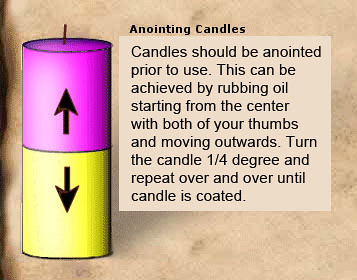
The method for anointing your candle is pretty specific. The most general method is to hold the candle in one hand, dip the first two fingers of the other hand in oil and starting at the top (the end with the wick) run your oiled finger down toward the centre of the candle. Stop at the centre, lift your finger off, turn the candle slightly and repeat the process until all the top half of the candle is covered. Then starting at the base of the candles, run the oiled fingers toward the centre. Again stop at the centre, lift the fingers off, turn the candle slightly and repeat the process until the entire bottom of the candle has been coated.
The whole time your are anointing the candle, concentrate on the outcome you wish to achieve with your spell. Experienced spell weavers often anoint the candle in a specific direction depending on the type of spell they are performing. For spells to attract something to the spell weaver, the candle is anointed from top to middle, then from bottom to middle. For banishing or sending something away i.e.. getting rid of bad habits, negative energy, breaking jinxes or hexes, the candle is dressed from the centre out to the top, and then from the centre out to the bottom.
Once the candle is coated in oil, it can be rolled in herbs relevant to the particular spell you are performing. For example, use Agrimony for breaking hexes and returning them to sender, use Chamomile for attracting friendship, Hyssop for purification and cleansing, Patchouli for wealth and so on. Once you have lit your spell candle and performed your spell, allow the candle to burn itself out completely.

Monday, October 24, 2011

Chaos Magic

 
What is Chaos Magic?
First off, an article explaining Chaos Magic probably doesn’t belong in a strictly Pagan listing of traditions. Since many Pagans may be into certain occult practices, they may have heard of Chaos Magic. This article was written for two reasons: To counter any preconceptions or prejudices some Pagans may have towards it; and to show the beautiful and vivid collection of approaches to magic that fall under the term. There are also many Pagans of various traditions who practice Chaos Magic, so perhaps this can enlighten the rest as to what they are up to.
Chaos Magic (CM) is strictly speaking, a set of approaches to magic that strip away a lot of occultist pedantry and get right down to the bare bones of magical activity itself. The criteria for success first includes observable results. These results can usually be shown to be replicable. The problem is that with any practice involving human individuals, there are variations and an individual’s personal system of beliefs or sense of what is possible can affect the results. (Parallel examples of this can be found in other human fields such as art or music if you need an example.)
In the first decade or so of CM, it wasn’t so much a magical tradition or paradigm in itself but more of a “metaparadigmatic” approach. Beliefs were seen as simply emotive and mental tools to use in rituals to accomplish whatever the group or individual practitioner’s goals were. Though, since those times, CM has accrued to itself some pretty standard and distinctive elements and practices, these could still be seen as a means to an end and not to be used towards establishing any sort of new magical body of beliefs and rituals. Despite this stance, CM may be seen as its own distinctive tradition, depending on the group or individual practitioner.
To get a handle on what CM is, it may be useful to describe the difference between one who practices CM and someone who practices, say Wicca. Whereas a Wiccan is a follower of the religion and belief system of Wicca, CM itself doesn’t mean its practitioners adhere to any one tradition or set of beliefs. Thus the CM practitioner could very well be a Wiccan, a member of Asatru, or a Druid. Usually the Chaos Magician is the type of individual who can successfully see the world from within more than one belief system or paradigm. In this spirit, many Pagans who are polytheists may also be practitioners of CM and not even know it. Many successful and well-known practitioners of CM are conscious members of one or more Pagan traditions or occult groups as well.
Chaos Magic can be seen as the heir to all of the magical traditions of humanity that stretch back to the distant and mostly imagined prehistory of our species. The one key difference is that outside of any useful belief in any sort of continuity with the past, Chaos Mages care little to nothing about philosophizing or taking it too seriously. The focus is on magic itself and the joy that can be ours by simply paying attention to the fact that reality is so much more than any one of our minds can conceive. Reality will and often does allow a certain amount of flexibility and tends to conform to the ways in which we see it. The point of CM is not to allow for any sort of solipsism to arise from this knowledge (which is a perennial danger) but to get the Chaos Mage to see exactly what is “really going on.” This can only be done if one is willing to allow that all of what one thinks about reality is in one’s mind. So we allow ourselves to play with the mind, to see just how much of reality may or may not be influenced or filtered through our mind. It is the mind that is one of reality’s most beautiful expressions of magic, and contrary to what some may argue, the mind is one of the most flexible and fickle aspects of our existence.
It also helps to have a flexible and infinitely adaptable mind so that one will be able to handle life on the day reality simply does not conform to one’s own conceptions. If beliefs are holding you back from succeeding at an endeavor, than CM would say (if it could say anything) that one should jettison those beliefs and adopt something that will work better. This will lead (and has lead) to some interesting developments in the practice of magic within the CM approach.
Author: Irreverend Hugh, KSC
Posted: February 18th. 2007

Sunday, October 23, 2011

The Chakra or Chakka means “Wheel” in Sanskrit. 
The Chakra are energy points. There are 7 diffrent points in the body where energy is absorbed. The 7 Major Chakras are:
  1. Sahasrara: The Crown or top of head - This color is purple and symbolized by the Amethyst stone.
  2. Anja: The Brow or “Third Eye” - This color is dark blue and symbolized by the Sodalite stone.
  3. Vishuddha: The Throat - This color is light blue and symbolized by the Aquamarine stone.
  4. Anahata: The Heart - This color is green and symbolized by the Malachite or Jade stone.
  5. Manipura: The Solar Plexus or diaphram- This color is yellow and symbolized by the Citrine stone.
  6. Svadisthana: The spleen or womb area - This color is orange and symbolized by the Carnelian stone
  7. Muladhara: The spinal base - This color is red and symbolized by the Garnet stone.
The 4 Secondary Chakras located in the center palms of the hands and bottom arch of the feet.
The 8 Minor Chakras are the knees, elbows, shoulders and thighs.
Many times you will hear about Chakras being off balance or blocked. This just means that one of your energy points is not absorbing energy. This can be easily remedied though meditation and focusing.
How to clear and open up your Chakras
As you concentrate on each area, your chakra should feel warm, letting its location and presence be known. Now that you have located each of these areas, you can begin a clearing exercise. The purpose of this exercise is to push built up energies out of your body to allow a healthy flow of spiritual energy.
Find a comfortable position. You can lay with your feet elevated or sit in a comfortable position. Your back must be perfectly straight. Posture is very important. Consider your spine a pipe through which water must flow. If the pipe is bent, the water will need force behind it to move.
Now that you are positioned, remind yourself that you are a spiritual being as well as a physical being. Life itself is a spiritual experience.
Bring your concentration to your base chakra. Take a deep breath. Hold this breath and concentrate on the base chakra. When you can visualize this ball of energy, release your breath, and push the tension from this area up to the next chakra.
Repeat though all 7 Chakra points
Doing this on a regular basis should reduce your physical stress increase your energy, and give you a more positive outlook on life.

Friday, October 21, 2011

Witches Ladder

Since olden times, feathers have been collected for magickal uses. One of the most famous charms using feathers is the Witches Ladder. For a Witches Ladder, three different colored yarns or ribbons are braided together, the colors depending on the purpose of the spell. I am going to use white for the maiden, red for the mother and black for the crone. Nine feathers are worked into the braid.

The magickal qualities of feathers are determined by their colour. Listed below is feather lore from European folk magick sources. You'll find it differs slightly from that of color symbolism in general.

I am also going to add in any beads or herbs I feel are right and necessary, it is going to be an interesting exercise!

FEATHERS & THEIR COLOURS

WHITE - White feathers symbolize purification, spirituality, hope, protection, peace, and blessings of the Moon.
RED - Red feathers symbolize physical vitality. Also courage, good fortune, and life.
BLUE - Blue feathers give mental abilities, peace, and protection. Also psychic awareness.
YELLOW - Yellow feathers give cheerfulness, mental alertness, prosperity, and blessings from the Sun.
GREEN - Green feathers symbolize money, prosperity, growth, health, and fertility.
Green and red mixed feathers affect financial matters.
ORANGE - Orange feathers bring attraction, energy, and success.
PINK - Pink feathers attract love.
GRAY - Gray feathers symbolize peace and neutrality.
BROWN - Brown feathers give stability and respect. They also symbolize the home and grounding.
Brown feathers striped in black, like the tail feathers of a pheasant, give a balance between the physical and spiritual life.
Brown feathers banded or mixed with white bring happiness and give the kind of protection that enables one to go unnoticed amidst those who would harm them.
Brown and red mixed feathers bring healing to animals.
BLACK - Black feathers give the mystical wisdom that comes with true spiritual initiation.
Black, iridescent feathers give mystical insight.
Black and white mixed feathers give union and protection.
Black (or gray) feathers banded or mixed with white give hope, balance and harmony.
Black mixed with purple means deep spirituality.
Black, white, and blue mixed feathers brings change.

Black ones are sacred to the God because of their resemblance to the curved horns of the Horned God. They are also a symbol of male virility. The white ones are sacred to the Goddess because they resemble the tool (the sickle) with which grain (sacred to her) is reaped. They also resemble the waxing and waning Moon.

I am going to be making these ladders whilst in circle.

As I begin to braid, I will be chanting this:

Yarn of red, black, and white
Work your magick spell this night
.

As I insert the feathers, begin this or a similar chant:

With this feather/bead/herb and this string,
Protection, happiness and peace this charm will bring.

Then I will consecrate the ladder by passing it through incense smoke and candle flame, asperge it with salt and water, saying:

In the names of the Goddesses
And the God
By Air, Earth, Fire, and Water
I consecrate this charm
Of feathers nine and cord of three
As I will, so mote it be!

The witches ladders can be hung in anywhere in your home to promote a welcoming and pleasant atmosphere or by your altar to aid in magickal workings.